
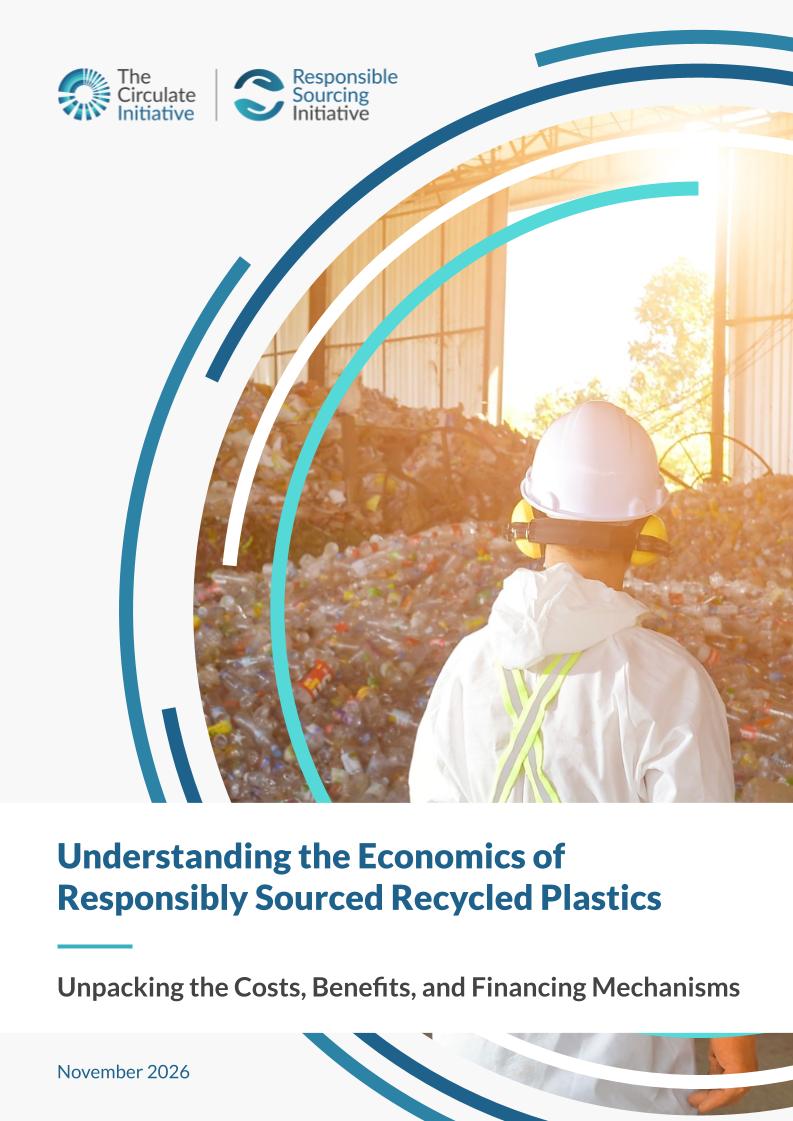
Understanding the Economics of Responsibly Sourced Recycled Plastics: Unpacking the Costs, Benefits, and Financing Mechanisms
As expectations around human rights due diligence, supply chain transparency and responsible business conduct grow, recycling businesses need to understand what it costs to strengthen responsible sourcing while remaining commercially viable. A clearer picture of these costs can help recyclers, buyers and financing partners discuss how to share them.
This report unpacks the costs and benefits along with possible financing mechanisms to cover these costs. Using the Harmonized Responsible Sourcing Framework for Recycled Materials, The Circulate Initiative estimated cost of responsibly sourced recycled plastics based on case studies in India and Kenya. Building on those findings, the full report examines where investment is needed, how it can be financed and what economic, social and environmental value responsible sourcing can create.
Key insights from the report include:
- Responsible sourcing adds an estimated US$ 40–50 per tonne to the cost of recycled plastic: This represents an increase of 9 to 11% for rPET in India and 17 to 24% for polyolefins and 26 to 31% for rPET in Kenya.
- Market and business maturity influence the nature and distribution of responsible sourcing costs: The responsible sourcing costs need to be understood in the context of existing market conditions and business capacity, rather than through a single cost estimate.
- Responsible sourcing is predominantly a direct and recurring business cost, rather than a one-time investment: Initial costs are high to establish systems and mitigate salient risks.
- The transition to responsible sourcing requires a combination of financing mechanisms: These can include buyer premiums and purchasing commitments, grants and catalytic funding, Extended Producer Responsibility (EPR), plastic credits, and results- or outcomes-based financing.
- Responsible sourcing can create tangible benefits, including economic, social, and environmental value beyond compliance: Potential benefits include reduced business risks, improved worker livelihoods and reduced waste leakage. These benefits may take time to materialize.

Read Report
*By clicking the "Download" button, you are agreeing to The Circulate Initiative’s Terms of Use and Privacy Policy.